

Slate Patio Restoration in Tiburon: Cleaning, Stripping & Sealing
Outdoor slate can be beautiful, especially the multicolored irregular slate commonly found on patios throughout Marin County. But years of moisture, dirt, algae, failed sealer, and coastal weather can leave the stone looking cloudy, dark, uneven, and much older than it really is.
This slate patio restoration project was completed in Tiburon, near Belvedere in Marin County. The patio had a high-gloss lacquer-style coating that had begun to fail, peel, haze, and trap dirt. Mold and algae were also growing across portions of the stone and grout, making the natural color of the slate difficult to see.
Instead of covering the problem with another layer of sealer, we stripped away the failed coating, detailed the slate and grout by hand, removed the heavy buildup, and applied a more appropriate protective finish for the exterior stone.
If your slate is dull, dirty, hazy, peeling, or increasingly difficult to maintain, learn more about our professional slate cleaning, sealing and restoration services throughout Marin County, the Bay Area, and Northern California.

Why This Slate Patio Had Become Cloudy, Dirty and Uneven
The slate itself was not the only problem. A previous high-gloss topical coating had begun to deteriorate from years of outdoor exposure.
Once an exterior coating starts failing, it can peel, turn cloudy or hazy, wear unevenly, and allow dirt to collect in damaged sections. Outdoor moisture, shade, irrigation, leaves, and organic debris can also create favorable conditions for algae and other biological growth.
In this case, dirt and organic buildup were visible throughout the grout and across the irregular surface of the multicolored slate.


Step 1: Removing the Failed Slate Sealer
The first major step was stripping away the deteriorated lacquer-style coating from both the slate and the grout.
This is where detailed preparation becomes critical. If patches of the old finish remain, they can interfere with cleaning and cause the next sealing system to look uneven or bond inconsistently.
Irregular slate makes that process especially challenging because the stone is not perfectly flat. It contains natural clefts, texture, grout joints, edges, low spots, and variations from one piece to another.
For projects involving failed coatings, our tile cleaning and sealer stripping service focuses on removing the old finish before attempting to rebuild the appearance of the stone.


Step 2: Deep Cleaning the Slate and Grout by Hand
Once the failed finish was removed, each section of the slate could be cleaned much more thoroughly.
We worked across the patio by hand, detailing the natural clefts in the slate, grout joints, edges, corners, transitions, and difficult areas near the structure. That level of detail matters because dirt and old finish can remain in low areas that broad machine cleaning may miss.
The toughest part of this particular project was removing the small areas of organic buildup that had worked into sections where the previous sealer had already failed.
This hands-on approach is also explained in our guide to slate floor refinishing and deep cleaning, where we discuss why irregular slate often needs more detailed restoration than routine surface cleaning.
Exterior Slate Should Be Treated Differently From Interior Slate
An outdoor patio has to deal with conditions that interior slate never experiences at the same level, including rain, irrigation, direct sunlight, temperature changes, drainage, standing moisture, dirt, and organic debris.
That is why the same high-gloss topical finish that may be appropriate for certain indoor applications should not automatically be used outdoors.
Exterior sealing needs to be selected based on the specific type of slate, the condition of the stone, moisture exposure, drainage, existing coatings, and the appearance the homeowner wants.
Step 3: Resealing the Slate and Restoring Its Natural Color
After the old coating was removed and the stone was thoroughly cleaned and allowed to dry, the patio could be resealed with a system better suited to the exterior installation.
The purpose of the sealer is to help reduce moisture and contaminant absorption while allowing the natural variation in the slate to remain visible. It does not make porous slate completely waterproof or eliminate future maintenance.
Once the old haze and contamination were removed, the natural reds, greens, grays, golds, browns, and other tones in the multicolored slate became much more apparent again.

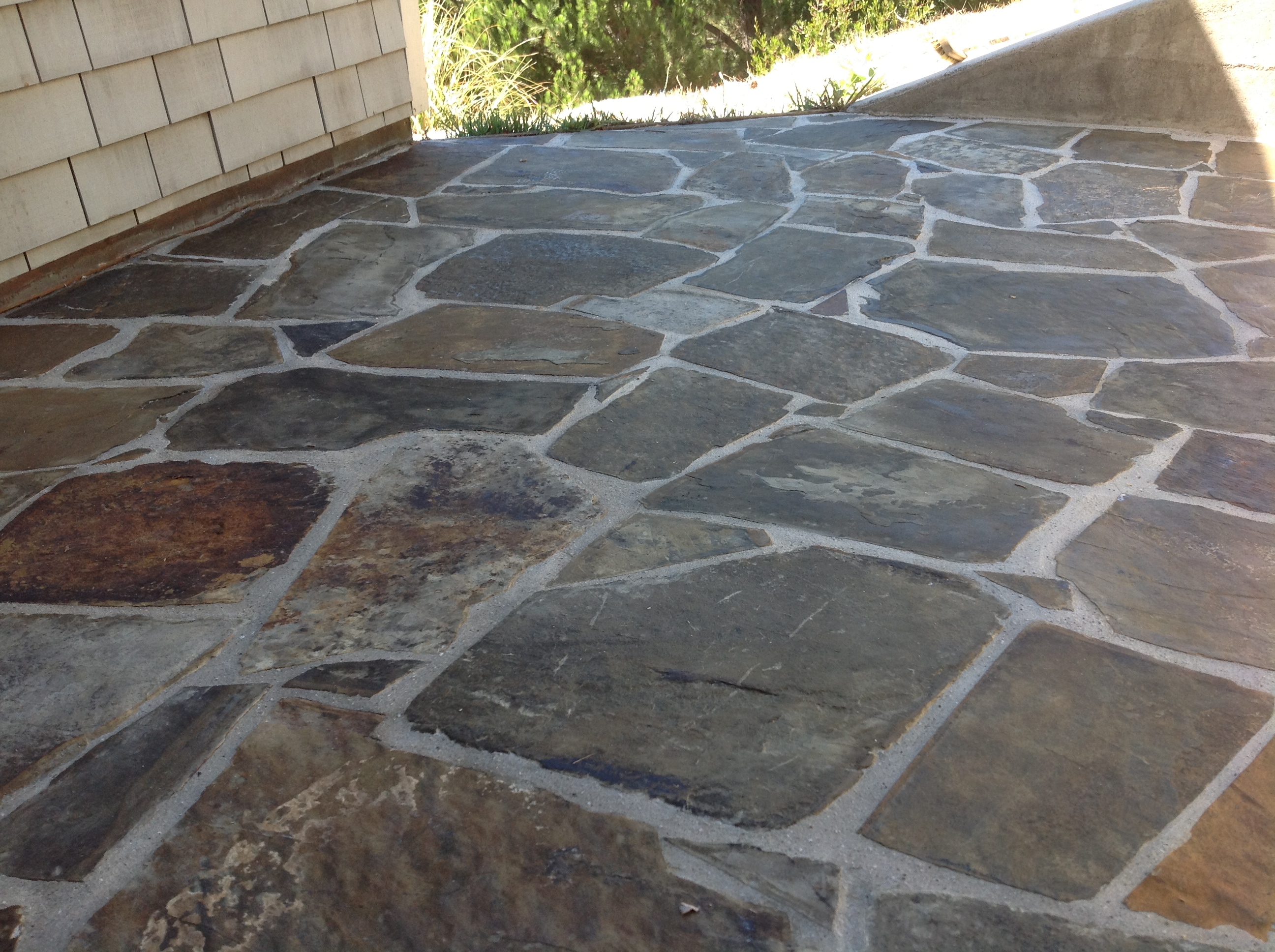


The Finished Tiburon Slate Patio
The completed patio looked dramatically different from where the project began.
The cloudy failed coating was gone, the slate and grout had been meticulously detailed, the organic buildup was removed, and the natural variation in the stone was visible again.
That is one of the benefits of restoring natural stone rather than immediately replacing it. Slate that looks permanently worn or dirty may still have decades of usable life when the underlying stone remains in good condition.
You can see additional examples of restored slate, Saltillo, flagstone, brick, and natural stone in our tile and stone restoration gallery.
How Can You Tell When an Outdoor Slate Patio Needs Restoration?
Some exterior slate needs only routine cleaning and maintenance. Other patios have reached the point where the existing coating or years of buildup need to be removed before the stone can be properly restored.
Signs that a more complete restoration may be appropriate include:
- Sealer that is peeling, hazy, cloudy, or whitening
- Slate that still looks dirty immediately after normal cleaning
- Algae or organic buildup returning repeatedly
- Dirt embedded in grout joints and textured sections of stone
- Uneven color caused by deteriorated coatings
- Areas where old finish remains while other sections have worn away
- Natural slate colors that have become difficult to see beneath years of buildup
For broader natural stone problems, our stone and marble restoration services cover cleaning, sealing, honing, polishing, grout repair, and restoration for a variety of stone surfaces.
Slate Patio Restoration in Tiburon, Belvedere & Marin County
California Tile Restoration provides professional slate cleaning, sealer removal, refinishing, and sealing throughout Tiburon, Belvedere, San Rafael, Marin County, Sonoma County, Napa County, and surrounding Bay Area communities.
Fritz Wittmann brings more than 23 years of hands-on tile and stone restoration experience to projects involving slate, Saltillo, terracotta, flagstone, marble, brick, and other porous surfaces.
The goal is to identify what is actually wrong with the stone, remove failed materials when necessary, and restore the existing surface rather than automatically covering it or replacing it.
Is Your Slate Patio Driving You Crazy?
If your slate is dirty, hazy, moldy, peeling, or covered with a failing old finish, it may be a restoration problem rather than a replacement problem.
View Our Slate Cleaning, Sealing & Restoration Services
Call Fritz Wittmann at (707) 384-1172
Frequently Asked Questions About Outdoor Slate Patio Restoration
Can a dirty outdoor slate patio be restored?
Often yes. If the underlying stone is still in suitable condition, old coatings, embedded dirt, grout buildup, algae, and other exterior contamination can often be addressed through professional stripping, deep cleaning, detailing, and resealing.
Why does exterior slate sealer turn cloudy or hazy?
Exterior coatings can deteriorate because of moisture, sunlight, weather exposure, drainage conditions, age, and incompatibility with the stone or environment. When a coating begins to fail, it may turn cloudy, white, hazy, uneven, or begin peeling from the surface.
Should old slate sealer be removed before resealing?
If the existing coating is deteriorated, peeling, cloudy, uneven, or trapping dirt, it may need to be removed before a new sealing system is applied. Proper preparation helps the new finish perform more consistently.
Can mold and algae be removed from slate patios?
In many cases, biological buildup can be significantly reduced through appropriate professional cleaning. The correct process depends on the slate, existing coating, grout, moisture conditions, and severity of the growth.
Does sealing an outdoor slate patio make it waterproof?
No. Slate is a natural stone, and sealing does not make the installation completely waterproof. An appropriate sealer can help reduce moisture and contaminant absorption and make the surface easier to maintain, but drainage and exterior exposure still matter.