
3 Saltillo Tile Cleaning & Restoration Mistakes to Avoid
Saltillo tile and Mexican pavers require very different care than conventional manufactured tile. Using the wrong cleaner or restoration method can damage the existing finish, alter the natural clay surface, or leave the floor looking worse than when you started.
After more than 23 years of hands-on tile restoration experience, Fritz Wittmann has seen homeowners receive plenty of advice that may work perfectly well on other flooring but can create problems on porous Mexican clay tile.
Three recommendations in particular deserve caution: cleaning Saltillo with vinegar, sanding the tile, and relying on steam cleaning to restore a deteriorated finish.
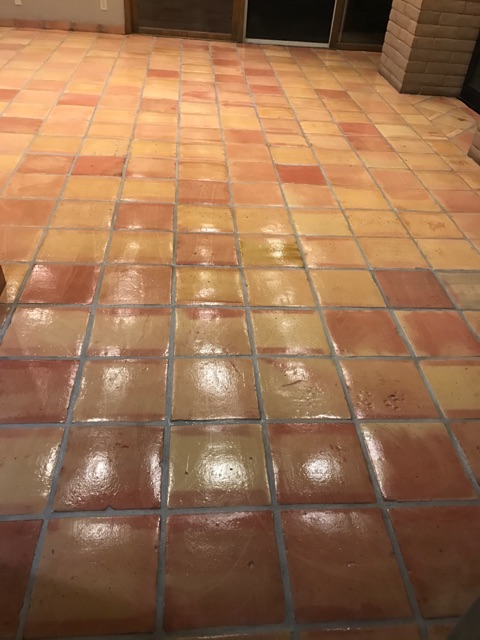
Mistake #1: Cleaning Saltillo Tile With Vinegar
One of the most common pieces of DIY advice is to clean tile with a mixture of hot water and vinegar. Fritz does not recommend this approach for sealed Saltillo and Mexican paver floors.
Vinegar is acidic. On a properly finished Saltillo floor, repeated exposure to inappropriate acidic cleaners can affect the protective finish you're trying to preserve.
A better approach for routine maintenance is a neutral, low-sudsing cleaner combined with proper hand cleaning. The goal is to remove surface dirt without unnecessarily attacking the existing protective finish.
If ordinary cleaning no longer improves the appearance of the floor, the problem may not be the cleaner at all. Dirt and discoloration can become trapped within a deteriorating sealer, at which point the floor may require professional tile cleaning and sealer stripping rather than increasingly aggressive household chemicals.
For a more detailed explanation, read our guide to cleaning Saltillo tile with vinegar and safer alternatives.
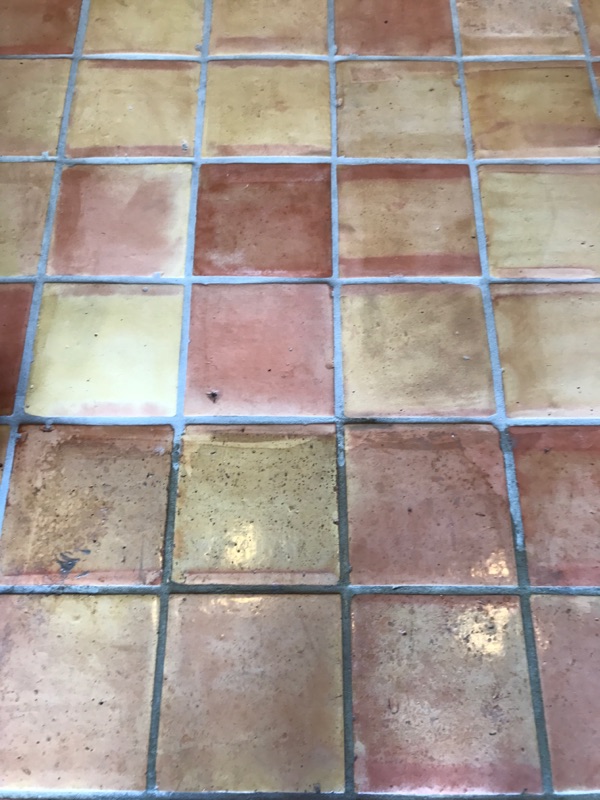
Mistake #2: Sanding or Grinding Saltillo Tile
Saltillo is a soft, porous clay tile—not a conventional hard manufactured floor. Aggressively sanding or grinding the surface can permanently alter the tile and remove the natural character and patina that make handmade Mexican pavers unique.
It can also leave behind a dusty mess and expose an increasingly porous surface that then requires additional preparation and sealing.
California Tile Restoration approaches these floors differently. Fritz performs detailed restoration work by hand so grout joints, corners, edges, stairs, areas underneath cabinets, around toilets, and other difficult locations receive individual attention.
If the existing finish has deteriorated beyond routine cleaning, the appropriate solution may be to strip the failed finish and restore the Saltillo floor rather than sand the clay surface.
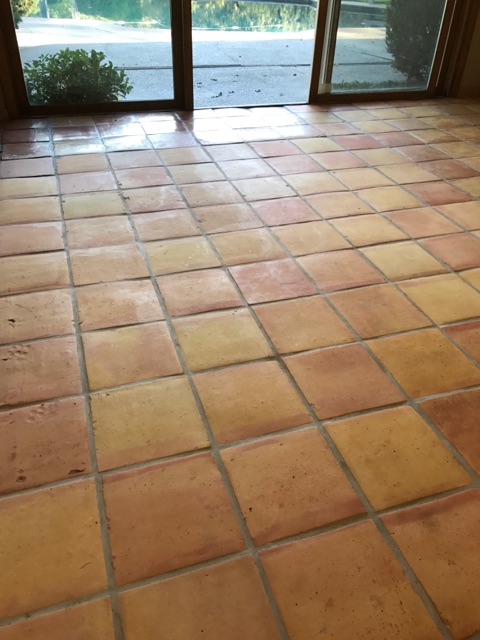
Mistake #3: Expecting Steam Cleaning to Restore Failed Saltillo Sealer
Steam cleaning is another method homeowners sometimes consider because it works well for certain other surfaces. The problem is that steam cleaning does not remove a deteriorated topical sealer or lacquer from Saltillo tile.
If the existing coating is already cloudy, peeling, contaminated, or failing, running a steam cleaner over the floor does not address the underlying problem.
Saltillo is also highly porous once its protective finish has been compromised. Introducing unnecessary moisture into a deteriorated floor can contribute to additional appearance problems rather than solving the failed-sealer issue.
The solution depends on the condition of the existing finish. A sound floor may simply need appropriate cleaning and maintenance. A floor with deteriorated coatings may require professional stripping, cleaning, and resealing or refinishing.
Why Saltillo Tile Requires a Different Restoration Approach
Saltillo and Mexican pavers are handmade clay products with variations in texture, color, porosity, and surface character. Treating them exactly like ceramic tile, carpet, or other manufactured flooring ignores those differences.
That is why California Tile Restoration performs detailed Saltillo restoration on hands and knees rather than depending on machines to do the entire job. Working directly with the floor allows Fritz to address individual tiles, grout joints, corners, hallways, bullnose pieces, stairs, and other areas that require detailed attention.
With more than 23 years of hands-on experience and more than 1,000 paver projects completed, Fritz has developed his restoration approach by working directly with these floors—not simply by following generic flooring advice.
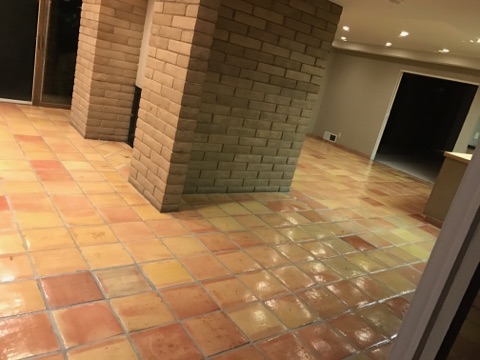
When Is It Time to Professionally Restore Saltillo Tile?
If your floor is simply dirty and the existing finish remains in good condition, proper maintenance may be all it needs. But if the Saltillo has become sticky, cloudy, dull, peeling, heavily stained, or increasingly difficult to clean, continuing to experiment with stronger DIY methods may make matters worse.
At that point, the condition of the existing sealer should be evaluated to determine whether the floor needs deep cleaning, sealer stripping, refinishing, or another restoration process.
Explore our complete tile restoration services to learn more about how California Tile Restoration works with Saltillo, terracotta, Mexican pavers, and natural stone.
Frequently Asked Questions
Should you clean Saltillo tile with vinegar?
Fritz does not recommend vinegar for routine cleaning of sealed Saltillo tile. Vinegar is acidic and can affect the protective finish. A neutral, low-sudsing cleaner is generally a better choice for routine maintenance of a properly sealed floor.
Can Saltillo tile be sanded?
Aggressive sanding or grinding can alter the surface and natural patina of soft Saltillo clay tile. If a floor has a deteriorated finish, removing the failed coating and properly restoring the tile is often a more appropriate approach than sanding the clay surface.
Can you steam clean Saltillo tile?
Steam cleaning does not remove failed topical sealer or lacquer from Saltillo tile. If the existing coating is cloudy, peeling, contaminated, or deteriorating, the underlying finish problem needs to be addressed rather than relying on steam cleaning alone.
Why does my Saltillo tile still look dirty after cleaning?
The dirt or discoloration may be trapped within a worn or deteriorating sealer rather than sitting on the tile surface. When that happens, stronger household cleaners may not solve the problem and professional sealer stripping may be necessary.
How should properly sealed Saltillo tile be cleaned?
For routine maintenance, Fritz recommends a neutral, low-sudsing cleaner and detailed cleaning rather than harsh chemicals. The appropriate method can change when the existing sealer has already begun to fail.
Need Help With a Saltillo or Mexican Tile Floor?
If your Saltillo tile is dull, cloudy, peeling, sticky, stained, or becoming impossible to clean, California Tile Restoration can help determine whether the floor needs cleaning, sealer stripping, refinishing, or a more complete restoration.
California Tile Restoration serves homeowners throughout San Rafael, Marin County, Sonoma County, Napa County, the Bay Area, and surrounding Northern California communities.
Call Fritz Wittmann at (707) 384-1172 to discuss your tile restoration project.
California Tile Restoration
CSLB #1074843