
A cloudy, failing finish does not always mean Mexican pavers need replacement. On this Palos Verdes patio, California Tile Restoration removed a deteriorated wet-look coating from 12-by-12-inch Lincoln pavers, cleaned the tile and grout, and refinished the surface to restore a more rustic appearance.
The project involved a poolside patio, stairs and walkways. The homeowner wanted to move away from the slippery, high-gloss finish described in the original project record and retain the character of the existing pavers.
The problem: white, cloudy sealer across the patio
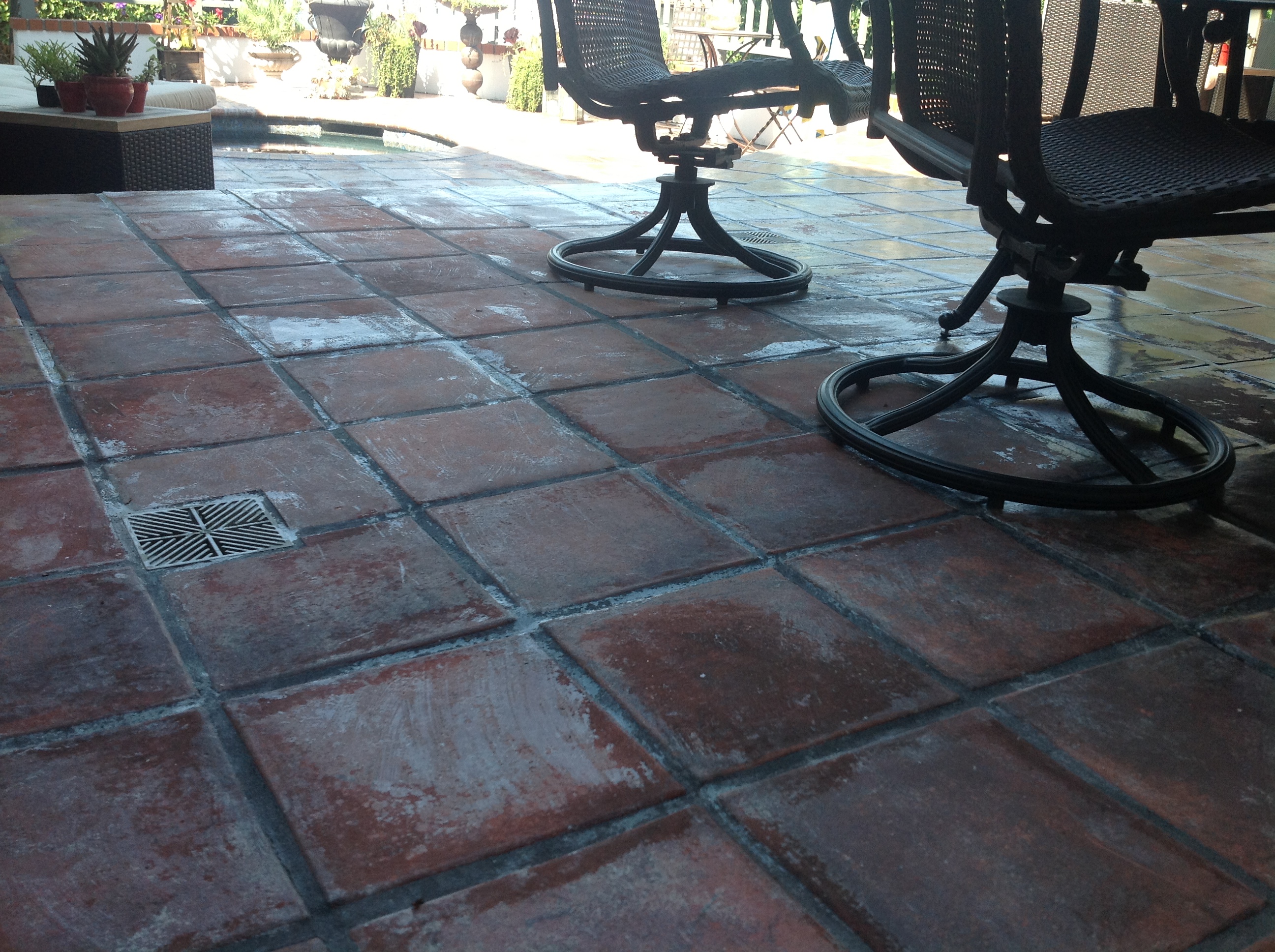
The initial photographs document a whitish, cloudy appearance across much of the tile and grout. The coating had become a concern for the homeowner, particularly where water from the pool reached the stairs and walking areas.
Cloudiness is a reason to assess the finish, not proof of one particular cause. Identifying the existing coating and testing the surface are important before choosing a removal or refinishing system.


Why the earlier removal attempt was not enough
The original account describes an earlier attempt using a stripping product and pressure washing. Some coating came away, but firmly bonded material remained, leaving the surface uneven and flaky.
For this project, removing only the loose material did not achieve the intended result. More detailed preparation was needed before the patio could be refinished.

For the broader discussion of equipment and porous surfaces, see why tile-cleaning machines can create problems on clay pavers.
A test area established the preparation needed
We prepared a sample to show the homeowner how the pavers responded to coating removal. The test also helped assess the buildup and the work needed to reach the underlying surface.
A sample on the actual patio is more useful than assuming a product or technique will perform the same way on every installation. Different coatings, previous treatments and tile conditions can change the scope of the work.


Removing the failed coating from pavers and grout
The removal was completed in stages. After working on the main coating, we returned to detail the pavers and grout by hand, paying particular attention to areas where residue remained strongly bonded.
The original project record notes especially heavy buildup near the house and on the stairs. It also records roughly 70 gallons of stripping product used during the project—an indication of the work involved here, not a product quantity or method to apply to another floor.
The photographs and video document the coating-removal stage. This was professional restoration work; the appropriate products and handling depend on the coating, surface and site.


Learn more about our tile cleaning and sealer-stripping service when an old finish needs attention.
The result: a more natural, rustic patio
Once removal and cleaning were complete, the pavers retained the natural patina and rustic Spanish-style appearance the homeowner wanted. The original account also notes areas of sun bleaching and deterioration that remained visible.
Those details matter: restoration can address a failed coating without making every paver look new or identical. Existing wear needs to be assessed and discussed before promising a result.


The patio was then resealed. A suitable finish should be selected for the material, exposure and intended use. Sealing should not be described as making a patio slip-proof, waterproof or immune to weathering.
What to check before adding more sealer
- Identify the existing finish. Do not assume that every shiny coating uses the same chemistry.
- Assess its condition. A new coat does not automatically resolve cloudiness, peeling or poor bonding beneath it.
- Use a representative test. Establish how the actual pavers and grout respond to the proposed preparation.
- Discuss the finished appearance. Natural variation and existing wear can remain visible after restoration.
- Plan maintenance. The selected system needs suitable cleaning and ongoing care.
For related signs of coating deterioration, read why clay tile can look dirty, peeling or dull. Our sealer guide explains options to discuss when planning work on Saltillo and related clay surfaces.
Mexican paver sealer-removal questions
Does white or cloudy sealer mean the pavers are ruined?
Not necessarily. The appearance may involve the finish, the underlying material or both. Assess the surface before deciding between maintenance, coating removal or other repairs.
Can you reseal over a failing coating?
Do not assume another layer will solve it. Identify the old finish, check compatibility and establish whether removal is needed before applying a new system.
Will stripping remove sun bleaching or all deterioration?
No. Coating removal does not automatically reverse changes or damage in the pavers themselves. This project retained some visible wear after restoration.
Discuss your Mexican paver patio
Contact Fritz Wittmann at California Tile Restoration. Include your city, photographs, the approximate area and any information about existing sealers or earlier removal attempts.
For a project in Palos Verdes or elsewhere in California, share your location so project suitability and availability can be discussed.
Discuss your paver restoration Call (707) 384-1172
Email: Fritz_wittmann@yahoo.com